
The March of Unreason
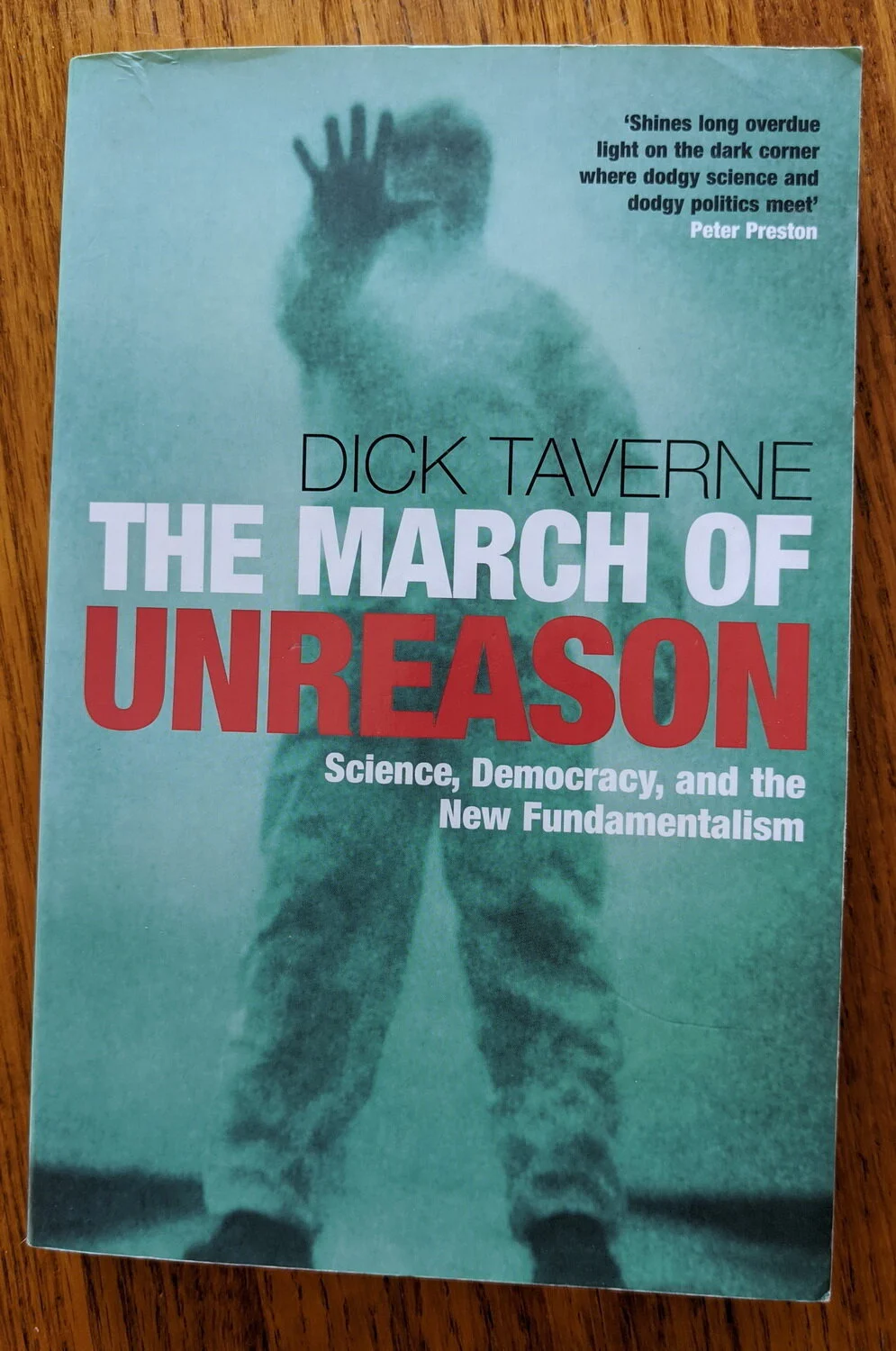
The March of Unreason by Dick Taverne published by Oxford University Press 2005.
This book has had the most profound effect on me!
About 20 years ago, I happened across a book review written by an Australian agricultural scientist in the Australian Institute of Agricultural Science journal recommending that we read a new book by Dick Taverne called The March of Unreason (Oxford University Press).
I am eternally grateful to the author and to whoever recommended it. Reading it then, and since, has confirmed my fears for the human race – and planet Earth – that our collective ignorance of science will be our undoing. My underlying concern is the complacency I detect as a widespread human frailty, especially in the wealthy and well-fed part of our populace.
Lord Taverne (1928–2025) trained as a barrister before serving as a British politician and member of the House of Lords. These experiences broadened his exposure to scientific issues whilst his wife, microbiologist Janice Hennessey, strongly influenced his understanding of science.
The March of Unreason describes in wonderful detail how we have been on a downhill slide from values developed during the Enlightenment to today when magic, myth, ideology and fundamentalism have challenged humanity’s commitment to reason and thereby threatened the foundations of democracy across the world. As he wrote in the Prologue, “That is why, as a liberal democrat in politics, a pragmatic environmentalist, a non-scientist but a passionate believer in the importance of reason and truth, I felt compelled to write this book”.
You can read some juicy quotes I have captured from his book by clicking here.
Not only did Taverne produce this profound book, but he was also instrumental in setting up a charitable trust, Sense about Science, which aims to promote the public understanding of science.
My support for the case made by Taverne led me to create this website so I can express a little of my own reasoning about a wide array of topics.